The Umpire's Last Call: When Institutions Drop Their Masks
The Umpire's Last Call: When Institutions Drop Their Masks
In 49 BCE, the Roman Senate faced a choice that would define the next four centuries of human history. Julius Caesar stood at the Rubicon with his legions, demanding that he be allowed to run for consul in absentia—a reasonable request that would have prevented his political enemies from prosecuting him the moment he returned to civilian life. The Senate, which had spent decades positioning itself as the impartial guardian of Roman law and custom, suddenly discovered that neutrality was no longer an option.
 Photo: Julius Caesar, via i.pinimg.com
They chose Pompey. They chose civil war. They chose the death of the Republic they claimed to protect.
Most importantly, they revealed that their celebrated neutrality had always been conditional—a performance maintained only as long as the fundamental power structure remained unchallenged. When forced to choose between their stated principles and their unstated loyalties, they didn't hesitate. The mask came off, and underneath was just another faction in Roman politics.
Two millennia later, we're still watching the same play with different actors.
The Mythology of the Impartial Arbiter
Every civilization invests enormous resources in creating institutions that claim to stand above politics. Courts that interpret law without bias. Central banks that manage currency without partisan consideration. Election commissions that count votes without favoritism. Press councils that police journalism without ideological agenda.
The psychological appeal is obvious: humans crave fairness, and fairness requires judges who have no skin in the game. We need referees who call balls and strikes regardless of which team is batting, umpires who make the tough calls without caring who wins or loses.
But this mythology obscures a deeper truth that five thousand years of history have demonstrated with depressing consistency: no institution exists in a political vacuum, and when the stakes get high enough, institutional self-preservation always trumps institutional principles.
The Federal Reserve's Political Awakening
Consider the Federal Reserve, America's supposedly independent central bank. For decades, Fed chairs cultivated an image of technocratic neutrality, making monetary policy decisions based purely on economic data rather than political considerations. This independence was zealously guarded and widely celebrated as a bulwark against short-term political pressures.
Yet when the 2008 financial crisis threatened the entire banking system, the Fed didn't just abandon its traditional restraint—it invented entirely new categories of intervention. Quantitative easing, direct bank bailouts, coordination with Treasury Department policy—all justified as emergency measures that transcended normal political boundaries.
The Fed maintained its neutrality for ninety-five years, then revealed in a matter of months that it had always been willing to become an active participant in fiscal policy when circumstances demanded it. The institution that claimed to stand above politics turned out to have very clear ideas about which outcomes were acceptable and which threatened the system it was designed to protect.
The Supreme Court's Selective Restraint
The U.S. Supreme Court provides an even starker example. For most of American history, the Court maintained its legitimacy by exercising what scholars call "judicial restraint"—deferring to elected branches of government except in cases where constitutional principles were clearly at stake.
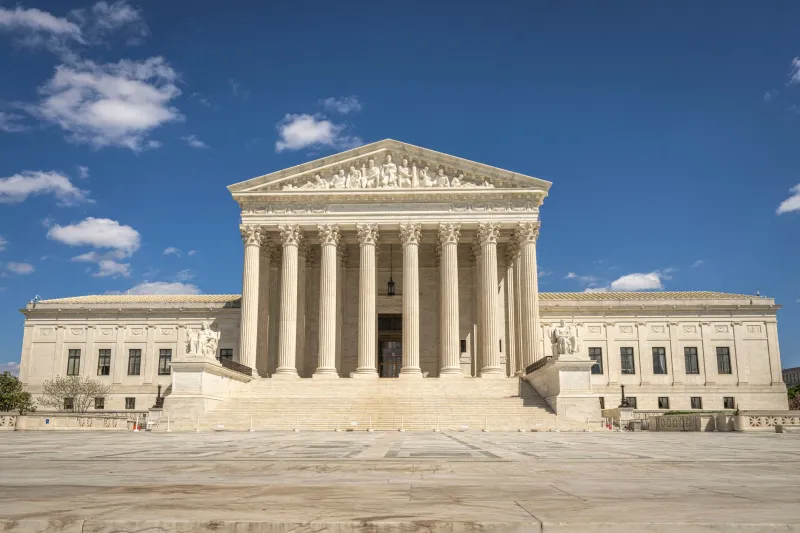
 Photo: Supreme Court, via files.redgifs.com
This restraint wasn't absolute, but it was predictable enough that both parties could generally accept the Court as a neutral arbiter of constitutional questions. Even controversial decisions like Brown v. Board could be understood as the Court fulfilling its proper role as guardian of constitutional principles against political pressure.
But that equilibrium has shattered in recent decades as the Court has repeatedly abandoned restraint in favor of sweeping decisions that remake American law along ideological lines. Citizens United, Shelby County, Dobbs—these weren't narrow constitutional interpretations but broad policy prescriptions that previous Courts would have left to the political process.
The Court spent two centuries building a reputation for neutrality, then systematically dismantled that reputation in pursuit of outcomes that no amount of legal reasoning could disguise as politically neutral. Like the Roman Senate, it discovered that institutional preservation sometimes requires institutional transformation.
The Press Council's Partisan Moment
Britain's Press Complaints Commission spent decades mediating disputes between newspapers and the public with studious neutrality, earning respect across the political spectrum for its fair-handed approach to media regulation. Then came the phone hacking scandal, and suddenly neutrality became impossible.
Faced with evidence of systematic criminal behavior by major newspapers, the PCC had to choose between protecting the press freedom it was designed to safeguard and acknowledging that some members of the press had forfeited any claim to that protection. The institution that had spent forty years avoiding political controversy found itself at the center of a constitutional crisis.
The PCC chose to defend the indefensible, revealing that its neutrality had always been conditional on the press behaving within acceptable boundaries. When those boundaries were crossed, the supposedly independent regulator became just another voice defending the industry it was meant to police.
The Pattern Behind the Pattern
These examples share a common structure that appears throughout history: institutions maintain their neutrality precisely as long as that neutrality serves the interests of the power structure that created them. When neutrality begins to threaten those interests, it gets quietly abandoned in favor of more direct intervention.
This isn't necessarily conscious conspiracy. Most institutional leaders genuinely believe in their own impartiality right up until the moment when impartiality becomes impossible. The Roman Senate probably convinced itself that opposing Caesar was a principled defense of republican government. Fed officials likely believed their crisis interventions were purely technocratic responses to economic emergency.
But self-deception doesn't change the underlying reality: institutions that claim to stand above politics are actually embedded within political systems, and their survival depends on those systems' continued stability. When the system faces an existential threat, institutional neutrality becomes a luxury no institution can afford.
The Impossibility of True Independence
The deeper problem is that true institutional independence may be psychologically impossible. Humans are social animals who form loyalties and develop interests. An institution staffed by humans and operating within a human society will inevitably develop preferences about which outcomes it considers acceptable.
Those preferences may remain hidden during normal times, when institutional principles align with institutional interests. But crisis has a way of forcing choices that reveal the hierarchy of values that was always present beneath the surface.
The Roman Senate's neutrality worked fine when it was mediating disputes between roughly equal factions within the Roman elite. It collapsed when faced with a leader who threatened the entire system of elite governance. The Fed's independence functioned smoothly when monetary policy could be separated from fiscal policy. It evaporated when that separation threatened financial system collapse.
The Price of Revealed Preference
Once an institution abandons its neutrality in a visible way, it can never fully reclaim that neutrality. The Roman Senate's choice to side with Pompey branded it as just another political faction for the rest of its existence. The Supreme Court's recent activism has permanently altered how Americans view its decisions, transforming constitutional interpretation into partisan scorekeeping.
This creates a dangerous dynamic: institutions that trade their neutrality for short-term political effectiveness often find that they've sacrificed their long-term legitimacy. The very people they were designed to serve begin to see them as captured entities whose pronouncements carry no special authority.
Yet the alternative—maintaining neutrality even when it threatens institutional survival—may be even more dangerous. An institution that refuses to defend itself when under attack may preserve its principles while losing its power to enforce them.
Five thousand years of this pattern suggest that the mythology of the neutral arbiter serves a valuable social function even when—especially when—it's ultimately unsustainable. The fiction of impartial institutions may be the best humans can do in a world where true impartiality is impossible but the appearance of fairness remains essential for social cohesion.
The umpire's last call reveals not institutional failure, but institutional humanity. And perhaps that's the most unsettling revelation of all.