Sacred Riots: The Sorting Process That Turns Some Mobs Into Monuments

Photo: Marc Merlin, CC BY-SA 4.0, via Wikimedia Commons
Every society that has ever existed has faced political violence from below — crowds that destroyed property, overwhelmed authorities, and forced outcomes that legal processes had refused to deliver. Every society that survived such violence then faced a second, quieter challenge: deciding, after the fact, which episodes represented the legitimate birth pangs of a better order and which represented criminal disorder that must never be repeated or celebrated.
This sorting process is one of the most consequential things a political culture does, and it is almost never conducted honestly. The criteria applied are rarely about the nature of the violence itself — its scale, its targets, its methods. They are almost entirely about its outcomes: who came to power, what story those people told, and how thoroughly the alternative story was suppressed.
The Boston Problem
The events of December 16, 1773, are worth describing with some precision, because the precision is usually avoided in the telling. A group of men — estimates range from 30 to 130 participants — disguised themselves as Mohawk Indians, boarded three ships in Boston Harbor, and destroyed 342 chests of tea belonging to the East India Company. The destruction was valued at roughly £10,000, equivalent to well over a million dollars today. The participants were careful to damage nothing else on the ships and to replace a broken padlock, which is sometimes cited as evidence of principled restraint. They then dispersed without being arrested.
The colonial authorities knew who many of the participants were. Prosecutions did not follow, partly because witnesses declined to cooperate and partly because the political climate made prosecution more costly than silence.
This is not a criticism of the Boston Tea Party. It is a description of it — one that the American founding mythology has consistently softened into a story about costumed patriots making a clean symbolic gesture. The softening is itself the phenomenon worth examining. The men involved understood they were committing an illegal act; that was, in part, the point. They were demonstrating that the law, as constituted, had lost its legitimacy with a significant portion of the population.
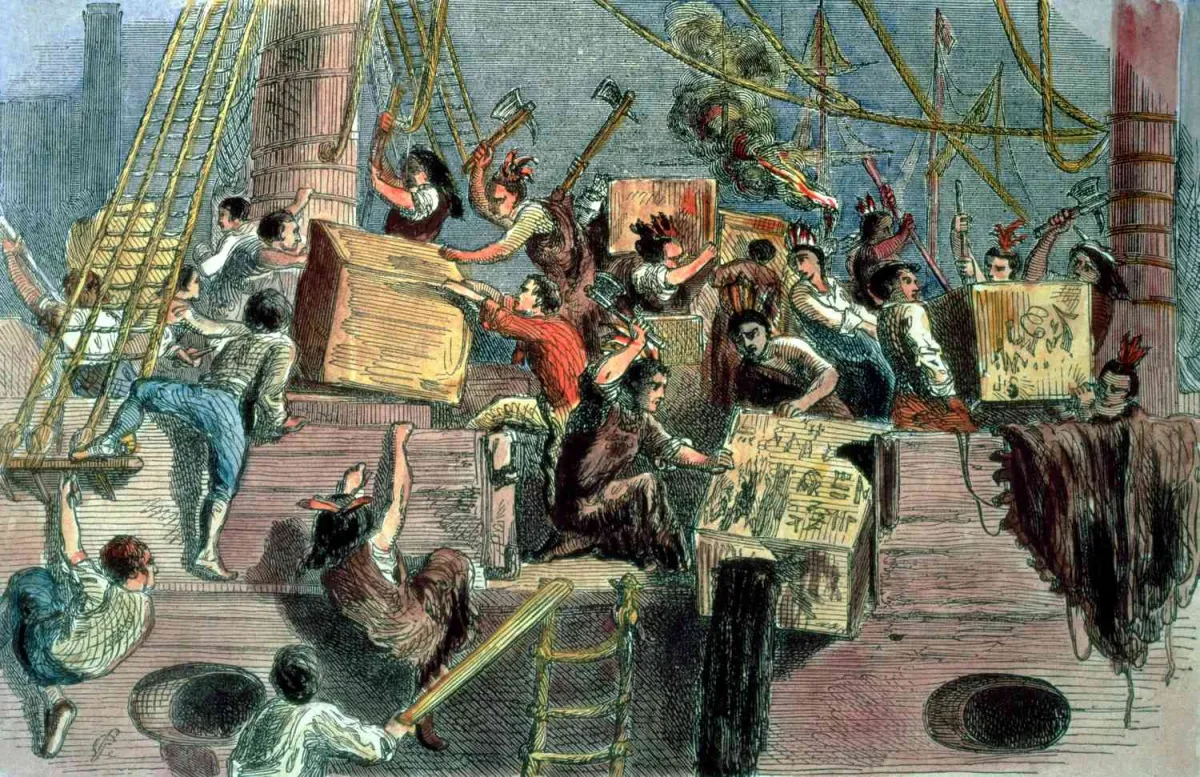 Photo: Boston Tea Party, via www.thoughtco.com
Whether that demonstration was justified is a political and moral question. Whether it was a riot is not.
Paris, 1789
The fall of the Bastille on July 14, 1789, involved a crowd that killed several guards, decapitated the fortress's governor, the Marquis de Launay, and paraded his head through Paris on a pike. The violence escalated over the following days and years into the Terror, during which the revolutionary government executed somewhere between 17,000 and 40,000 people, depending on how the accounting is done.
The French Revolution is not celebrated in American political culture the way the American Revolution is — though it was, for a significant period, enthusiastically supported by Americans including Thomas Jefferson, who wrote that "the tree of liberty must be refreshed from time to time with the blood of patriots and tyrants." Jefferson wrote those words in 1787, before the Terror, but the sentiment reflects a genuine strand of revolutionary thought that was not, at the time, considered extreme.
The French Revolution is now more commonly invoked as a cautionary tale about how revolutions devour themselves, how idealism curdles into authoritarianism, how the mob, once summoned, cannot be recalled. These are legitimate lessons. But it is worth noticing that they are lessons drawn from a revolution that failed to produce a stable republic, at least in its first several iterations. The American Revolution, which produced a stable republic — one that, not incidentally, wrote the history books — is drawn from differently.
The violence of the founding is not the variable that determines how the founding is remembered. The stability of what followed is.
The Sorting Mechanism
Across five thousand years of recorded history, the process by which political violence gets reclassified as either founding myth or criminal insurrection follows a remarkably consistent pattern.
First, there is the immediate verdict, which is almost always condemnation from existing authority. The Athenian establishment condemned Cleisthenes' democratic reforms as mob rule. The Roman Senate condemned the Gracchi's land redistribution movement as sedition. The British Crown condemned the American colonists as traitors. In each case, the authority with the power to define legality defined the challengers as criminals.
Second, there is the contest of outcomes. If the challengers win — militarily, politically, or simply by surviving long enough to write constitutions — the initial verdict gets reversed. The traitors become founders. The mob becomes the vanguard of history. The criminal act becomes the necessary spark.
Third, and most importantly, there is the retrospective narrative construction. This is where the real work happens. The winning side does not simply declare victory; it constructs a story in which the violence was not really violence, or was proportionate, or was forced upon reluctant actors by an intolerable situation that left no alternative. The losing side's violence, by contrast, is stripped of its context and presented as pure disorder.
The American Iteration, Continued
The United States has conducted this sorting process repeatedly throughout its history, and the results have been deeply inconsistent in ways that reflect the power dynamics of each era rather than any principled distinction between legitimate and illegitimate political violence.
Shays' Rebellion of 1786-87 — a revolt by Massachusetts farmers facing debt imprisonment — was suppressed and its leaders prosecuted, though later pardoned. It is remembered primarily as a cautionary tale that motivated the Constitutional Convention. The Whiskey Rebellion of 1794 was crushed by federal troops personally led by George Washington; its participants are not celebrated as patriots. John Brown's raid on Harpers Ferry in 1859 was condemned as terrorism by most of his contemporaries, including Abraham Lincoln; his current status in the American memory ranges from martyr to prophet depending entirely on the political valence of the person doing the remembering.
 Photo: Harpers Ferry, via i1.wp.com
The pattern is not that Americans are hypocrites — or not only that. The pattern is that human beings are constitutionally incapable of evaluating political violence through a consistent framework, because the framework we actually use is not principled but tribal: whose side were they on, and did that side ultimately win?
What the Consistency Reveals
The five-thousand-year consistency of this sorting process reveals something important about political legitimacy itself. Legitimacy is not a property that acts possess at the moment they occur. It is a property that gets assigned retroactively, by survivors, based on what the acts produced.
This is uncomfortable for anyone who wants a principled framework for evaluating political violence — and there are good reasons to want one. But the discomfort is instructive. It suggests that when contemporary political actors argue about whether a specific episode of collective violence was legitimate uprising or criminal insurrection, they are almost never actually arguing about the episode. They are arguing about whose future they want to live in.
The Boston Tea Party was not sacred when it happened. It became sacred when the revolution it helped catalyze produced a republic that lasted long enough to write school curricula.
The men in the harbor knew that. They were not making history. They were making a bet.
The Honest Question
The honest question that this pattern forces is not "was this violence legitimate?" That question, in the moment, is almost always unanswerable with confidence. The honest question is: "Who gets to answer that question, and when?"
The answer, consistently, across every culture and every millennium in the record, is: the winners, later.
This does not mean that all political violence is equivalent, or that no moral distinctions can be drawn in real time. It means that the sorting process by which societies consecrate some violence and condemn other violence is a political act, not a moral one — and that treating it as a moral act is itself a political choice, usually made in the service of whoever currently controls the narrative.
History does not repeat. But the argument about which history counts — that argument runs on a loop that five thousand years have not interrupted.