The Office That Would Not Release Its Tenant: America's Recurring Crisis of Democratic Departure
The Office That Would Not Release Its Tenant: America's Recurring Crisis of Democratic Departure
There is a particular kind of political crisis that democracies prefer not to discuss too directly, because discussing it requires admitting something uncomfortable: the peaceful transfer of power has never been guaranteed by any mechanism more reliable than the willingness of the person holding power to surrender it. Laws describe what should happen. Traditions reinforce expectations. But in the final accounting, departure is always a choice.
American history is populated by officials who made a different choice — or who discovered, at the precise moment their tenure ended, that the rules governing departure were somehow more ambiguous than they had previously appeared. The pattern is not a modern innovation. It is one of the oldest recurring dramas in democratic governance, and its psychological architecture has remained essentially unchanged across five thousand years of recorded political life.
The Reconstruction Precedent
The period following the Civil War produced some of the most brazen examples of officials redefining the terms of their own departure. In the former Confederate states, where the very legitimacy of federal authority was contested, the question of who held office and under what authority became genuinely violent. But the more instructive examples came not from outright resistance to federal power, but from the quieter maneuvering of officials who simply declined to recognize the legal basis for their removal.
In Louisiana, the disputed gubernatorial election of 1872 produced two men who simultaneously claimed the office, each supported by rival factions and each operating a functioning government in the same city. William Pitt Kellogg and John McEnery both issued proclamations, both collected what taxes they could, and both maintained that the other was an illegitimate usurper. The situation required federal troops to resolve — and even then, the resolution was contested for years. What made this possible was not legal ambiguity alone. It was the psychological reality that Kellogg and McEnery had each organized their entire political identity around the claim to office. To surrender the claim was to surrender themselves.
This is the mechanism that recurs. The law rarely provides a clean enough answer to make departure automatic. What fills the gap is either the official's personal willingness to accept the verdict or the presence of sufficient external force to compel it. When neither exists, the crisis follows.
The Bureaucratic Holdout
Not every refusal to leave is dramatic. Some of the most consequential examples have been bureaucratic rather than theatrical — officials who did not barricade themselves in statehouses but who instead used procedural authority to delay, obstruct, or simply ignore the transfer of power.
The post-Reconstruction South perfected this technique. As Reconstruction governments collapsed and redeemers took control, the transition was often managed through the capture of election certification machinery rather than through direct confrontation. The officials who controlled the counting, the certifying, and the recording of results found that these ministerial functions carried enormous discretionary power — power that could be deployed to produce outcomes that raw vote totals did not support.
This was not unique to the South or to the nineteenth century. The machinery of democratic transition — the canvassing boards, the secretaries of state, the county clerks — has always represented a potential chokepoint where the gap between what voters decided and what gets officially recorded can be widened by individuals who believe, or claim to believe, that the ordinary rules do not apply to this particular circumstance.
The Psychology of the Unreplaceable
Why does this happen? The ancient Greeks had a word for the condition — they called it pleonexia, roughly translated as the insatiable desire for more than one's share — but the psychological literature of the past century has refined the diagnosis considerably. What the historical record consistently shows is that officials who refuse departure have almost universally undergone a process of identity fusion with their office. They do not merely hold the position; they have become it.
This fusion is not vanity alone, though vanity is always present. It is also the product of genuine belief — the conviction that the cause served by one's continued tenure is larger than any procedural rule governing departure. Every holdout in American history has articulated some version of this argument. The election was fraudulent. The process was corrupted. The true will of the people has been thwarted. The official who stays is not, in their own account, refusing to leave — they are preventing an injustice.
The Romans understood this psychology well enough to build institutional safeguards against it. The consular system, with its rigid annual terms and its provision that two consuls must always share power, was designed specifically to prevent the identity fusion that made departure impossible. When Julius Caesar crossed the Rubicon, he was not merely violating a military regulation. He was enacting the precise scenario the republic's founders had spent centuries designing against — the general who had become so identified with his command that laying it down was psychologically equivalent to death.
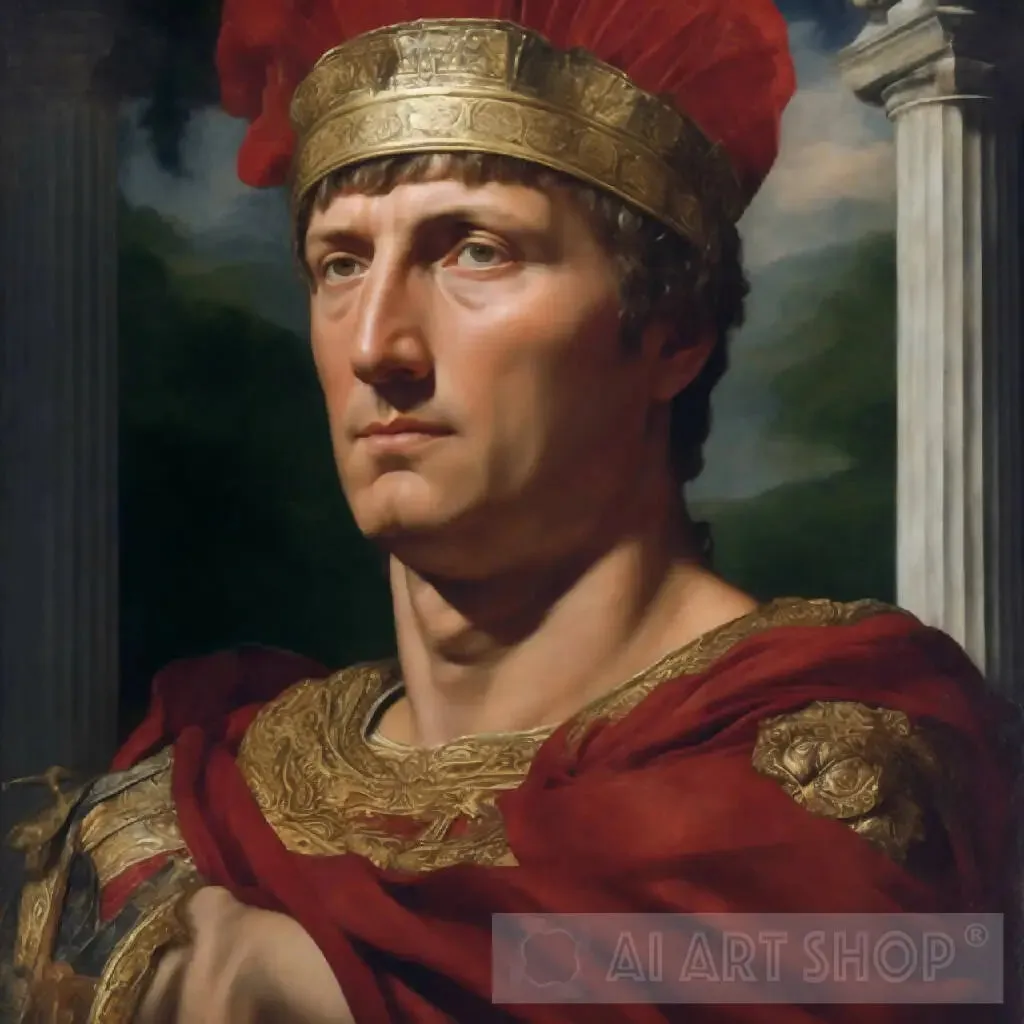 Photo: Julius Caesar, via aiartshop.com
The Modern Certification Crisis
The 2020 election and its aftermath introduced millions of Americans to the arcane machinery of democratic certification — the electoral college, the role of state legislatures, the function of the vice president in counting electoral votes. What looked like a constitutional crisis rooted in novel legal theories was, in its psychological architecture, entirely familiar.
The officials who declined to certify results in various counties, the state legislators who entertained proposals to appoint alternative electors, the federal officials who explored mechanisms for delay — each was operating within a tradition that is genuinely old. The specific legal arguments were new. The underlying dynamic was not. When personal identity and political office become fused, the official discovers that the law is always more ambiguous than it appeared, that the circumstances are always more extraordinary than the rules anticipated, and that the departure being demanded is always, somehow, the greater injustice.
What distinguishes the cases that resolved peacefully from those that did not is rarely the quality of the legal argument. It is almost always the presence or absence of sufficient institutional resistance — other officials, other power centers, other actors who declined to treat the extraordinary claim as ordinary.
What the Pattern Teaches
The lesson that five thousand years of political history offers on this subject is not reassuring. It is this: the peaceful transfer of power is not a product of constitutional design, though good design helps. It is not a product of democratic culture, though culture matters. It is, in the final analysis, a product of the personal decision of the official whose tenure has ended — and that decision is shaped by forces that institutional architecture can constrain but never fully eliminate.
The officials who left when they were supposed to leave deserve more credit than history typically gives them. Their departure was not automatic. It was a choice, made under pressure, in the presence of powerful incentives to stay. The officials who did not leave deserve more scrutiny than nostalgia typically permits. Their refusal was not unique. It was the expression of a psychological pattern so old and so consistent that its recurrence should surprise no one who has spent serious time with the historical record.
Democracies do not fail because departure becomes impossible. They fail because departure becomes, for enough people in enough positions, merely optional.