The Costume That Fits Too Well: How Republics Dress Strongmen in Their Own Clothes
There is a particular kind of political self-deception that recurs across five thousand years of recorded governance, and it is far more interesting than the brute seizure of power. It is the moment when a republic, genuinely frightened, reaches for the nearest strong man and wraps him in its own constitutional language — sincerely believing the language will contain him.
It almost never does.
The Magician's First Trick: Accepting Power Reluctantly
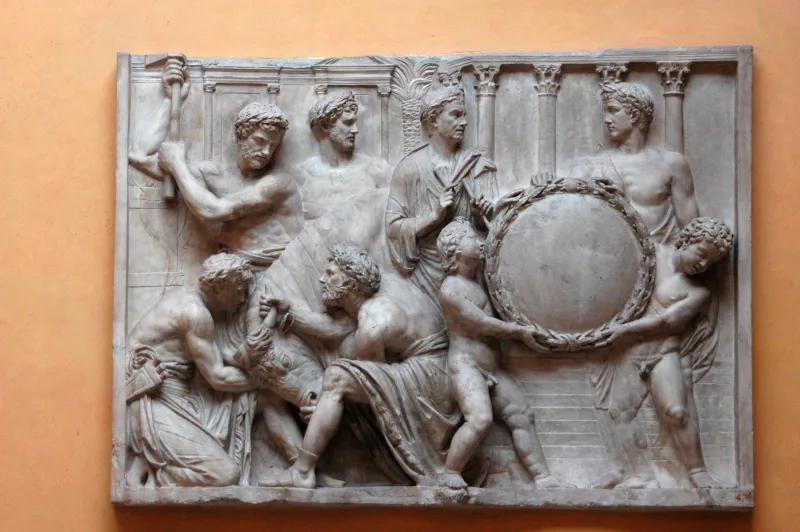
Octavian understood something that Julius Caesar, for all his brilliance, had not. Caesar wanted to be the king. Octavian wanted to be asked — repeatedly, publicly, with the Senate begging. When he accepted the title Princeps, meaning roughly "first citizen," in 27 BCE, he did so after a theatrical refusal and with elaborate assurances that the Republic's institutions remained intact. The Senate kept its chambers. Elections continued. Magistrates were duly appointed.
What changed was everything that mattered. Command of the armies, control of the grain supply, authority over the provinces that held the legions — these accumulated around one man while the decorative machinery of republican government continued to spin, reassuring and purposeless.
The Senate did not fail to notice. It chose not to notice. That distinction is important.
Augustus — the title the Senate itself awarded him, meaning "the venerable one" — governed for forty years. The costume became the man. By the time he died, no living Roman senator had served under an actual republic. The clothing had replaced the body inside it so gradually that the transition registered, in retrospect, as almost natural.
Why the Republic Reaches for the Strongman
The pattern requires a precondition: genuine fear. Not manufactured fear, not mere political anxiety, but the kind of institutional dread that makes otherwise careful people make large, irreversible decisions quickly. Rome in 27 BCE had just endured a generation of civil war. The republic's traditional mechanisms had produced Caesar, then his assassination, then Antony, then a second round of civil conflict. When Octavian offered stability at the cost of some constitutional ambiguity, the Senate's calculation was not irrational. It was simply fatal.
This is the uncomfortable historical truth that makes the pattern so durable: the republic's decision to conscript a strongman is usually made by intelligent people who believe they are being pragmatic. The alternative — continued dysfunction, factional violence, institutional paralysis — is real. The strongman's promise of order is real, at least in the short term. What is underestimated, every single time, is the permanence of the arrangement.
The Weimar Republic's parliamentary leadership did not hand Adolf Hitler the chancellorship out of stupidity. They did so because they believed they could manage him, that the coalition arithmetic would contain him, that the constitutional framework was stronger than one man's ambitions. Franz von Papen, who engineered Hitler's appointment, reportedly told a colleague he had "hired" Hitler. Within eighteen months, von Papen was hiding in an embassy to avoid being shot.
The American Temptation
The United States has its own version of this recurring negotiation, and it is worth examining without the comfort of historical distance. The American constitutional order has, on multiple occasions, extended extraordinary authority to the executive branch during periods of genuine emergency — and then discovered, with varying degrees of alarm, that emergency powers have a poor record of voluntary retirement.
Franklin Roosevelt's wartime consolidation of executive authority was largely accepted because the emergency was real and the man was trusted. But the institutional expansions outlasted the war. Harry Truman inherited a presidency substantially more powerful than the one Roosevelt had inherited from Herbert Hoover. Dwight Eisenhower, in his farewell address, named the phenomenon directly: a military-industrial complex that had become structurally resistant to civilian democratic oversight. He was describing, in part, what happens when emergency authority is normalized.
The pattern is not partisan. It predates every living American politician. It is structural.
What makes the American case particularly interesting is that the republic's founders were acutely aware of this dynamic. They had read their Plutarch. They knew about Caesar. The separation of powers, the explicit limits on executive authority, the two-term norm that Washington established — these were not accidental features. They were specifically engineered to resist the moment when a frightened republic reaches for a savior.
The engineering has held, imperfectly, for longer than most republics manage. But the psychological pressure that drives the pattern has not changed in five thousand years.
The Costume's Hidden Seam
There is a detail in Augustus's story that historians sometimes underemphasize. He did not simply wear the republic's costume — he believed in it, at least partially, at least at first. His letters and public statements suggest a man who genuinely saw himself as a restorer rather than a usurper. The costume was not purely cynical theater. It shaped him even as he shaped it.
This is perhaps the most unsettling aspect of the pattern. The strongman who accepts democratic dress often internalizes some portion of the role. He holds elections. He tolerates some press criticism. He maintains the forms. And because the forms are maintained, the republic's defenders face a problem that pure tyranny does not present: the tyrant's legitimacy is woven from the republic's own thread, and pulling it risks unraveling both.
Modern democracies that find themselves in this situation — and several do, at this writing — discover that the tools designed to resist usurpation are also the tools the costumed strongman uses to resist removal. He appeals to the constitution. He demands due process. He insists on the very norms he is systematically hollowing out.
The genius of the costume, after five thousand years of refinement, is that it fits in both directions.
What History Recommends
History does not offer clean solutions. It offers patterns, and the pattern here is grim enough to deserve sober attention. Republics that have successfully navigated this pressure — that have extended emergency authority and recovered it, that have elevated strong executives and returned to institutional balance — have generally done so through a combination of factors: robust competing institutions, an elite class with genuine investment in the system's survival, and a public that understood what it was risking.
None of those factors are automatic. All of them require cultivation long before the emergency arrives. The republic that waits until it is frightened to build its resistance to this pattern has, historically, waited too long.
The costume is already hanging in the wardrobe. The question is always who gets to decide when it comes off.