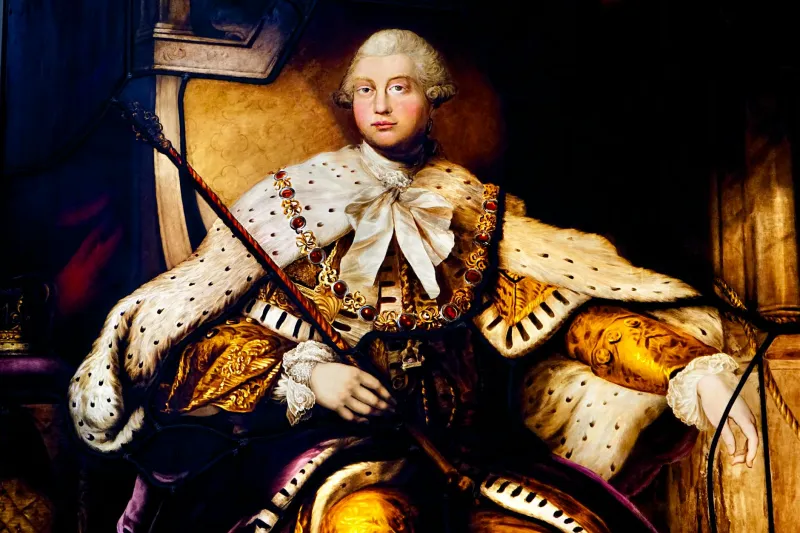
In 476 CE, as barbarian armies closed in on Ravenna, the Western Roman Empire's final emperor was a teenager named Romulus Augustulus. His father, Orestes, had seized power not through military genius or administrative skill, but through a singular qualification: absolute loyalty to the previous usurper. Around them, the machinery of government creaked along under officials chosen not for their ability to collect taxes or organize defenses, but for their unwavering devotion to a regime that had already lost the war.
 Photo: Romulus Augustulus, via worldhistoryedu.com
This scene has repeated across five millennia with the precision of a natural law. When power structures begin to collapse, those in charge consistently make the same fatal calculation: they mistake competence for a threat and treat loyalty as the only qualification that matters.
The Psychology of Paranoid Selection
The mechanism is as predictable as it is self-destructive. Leaders facing genuine existential threats develop what historians call "paranoid selection" — the systematic preference for subordinates who pose no challenge over those who might actually solve problems. The logic appears sound from inside a failing regime: competent officials have options, independent judgment, and the skills to potentially replace their superiors. Loyalists, by contrast, sink or swim with the current leadership.
Consider Leonid Brezhnev's Soviet Union in the 1970s. As economic stagnation deepened and technological gaps with the West widened, the Politburo didn't promote the economists who understood market mechanisms or the engineers who grasped why Soviet computers lagged decades behind American ones. Instead, they elevated party functionaries whose primary qualification was decades of never questioning Moscow's wisdom. By 1985, when Mikhail Gorbachev finally attempted reforms, the government's institutional knowledge had been so thoroughly purged that competent officials had to be imported from academia and regional posts.
 Photo: Mikhail Gorbachev, via c8.alamy.com
The pattern held in Weimar Germany, where President Hindenburg's circle repeatedly chose chancellors based on their perceived malleability rather than their ability to govern during economic crisis. When they finally settled on Adolf Hitler in January 1933, the calculation was explicit: they believed they could control him. The most competent conservative politicians had been sidelined precisely because they possessed the independence to potentially outmaneuver their supposed allies.
The Competence Trap
Why does this pattern persist across cultures and centuries? The answer lies in how human psychology processes existential threats. When leaders feel their position genuinely endangered, their risk assessment becomes fundamentally distorted. The immediate threat of a capable subordinate's potential betrayal looms larger than the abstract danger of institutional collapse.
This creates what we might call the "competence trap." The more skilled an official, the more alternative futures they can envision — including futures where current leadership has been replaced. From a threatened leader's perspective, someone who understands how to fix problems also understands how to cause them. Someone capable of saving the regime possesses, by definition, the tools to overthrow it.
The trap becomes self-reinforcing. As competent officials are marginalized, institutional performance deteriorates, which increases the leadership's sense of threat, which drives further purges of anyone with independent capabilities. The regime's problems multiply precisely because it has systematically eliminated those most qualified to address them.
Modern Manifestations
This ancient pattern echoes through contemporary American politics with uncomfortable clarity. Consider how modern administrations staff critical positions during times of crisis. When facing genuine challenges — economic downturns, foreign policy crises, natural disasters — the tendency to prioritize personal loyalty over relevant expertise becomes pronounced.
The 2008 financial crisis offers a case study. While some officials with deep financial expertise were retained or recruited, key positions were often filled based on political considerations rather than technical qualifications. The result was a response that, while ultimately successful, was hampered by institutional knowledge gaps that more merit-based selection might have avoided.
Similarly, the COVID-19 pandemic revealed how quickly expertise can be sidelined when it conflicts with political messaging. Public health officials who provided inconvenient assessments found themselves marginalized, while those who aligned their recommendations with preferred narratives gained influence regardless of their epidemiological credentials.
The Institutional Immune System
Democracies theoretically possess institutional antibodies against this pattern — civil service protections, confirmation processes, term limits that prevent the accumulation of paranoid selection over time. Yet these safeguards prove surprisingly fragile when leaders feel genuinely threatened.
The key insight from five thousand years of this pattern is that the problem isn't individual pathology but systemic psychology. Any leader facing existential threats will feel the same gravitational pull toward choosing loyalty over competence. The question isn't whether this temptation will arise, but whether institutions can be designed to resist it.
Rome's republic lasted five centuries partly because its competitive political structure made it difficult for any single leader to purge competent rivals completely. When that competition broke down during the civil wars, the pattern reasserted itself with devastating efficiency.
The Fatal Calculation
The ultimate irony is that paranoid selection produces the very outcome it seeks to prevent. By systematically choosing incompetence over capability, threatened leaders ensure their regimes become genuinely incompetent — and therefore genuinely threatened. The loyalists who seemed like the safest choice prove incapable of handling the crises that initially prompted the paranoid selection.
Every failing government tells itself the same story: this time, loyalty will be enough. This time, the problems aren't so complex that they require independent expertise to solve. This time, absolute devotion will substitute for actual capability.
History suggests otherwise. From Ravenna to Moscow to Berlin to Washington, the pattern holds: when merit becomes the enemy, the enemy eventually wins. The question for any democracy is whether it can recognize this ancient trap before falling into it — or whether it will convince itself, like every failing regime before it, that this time will somehow be different.