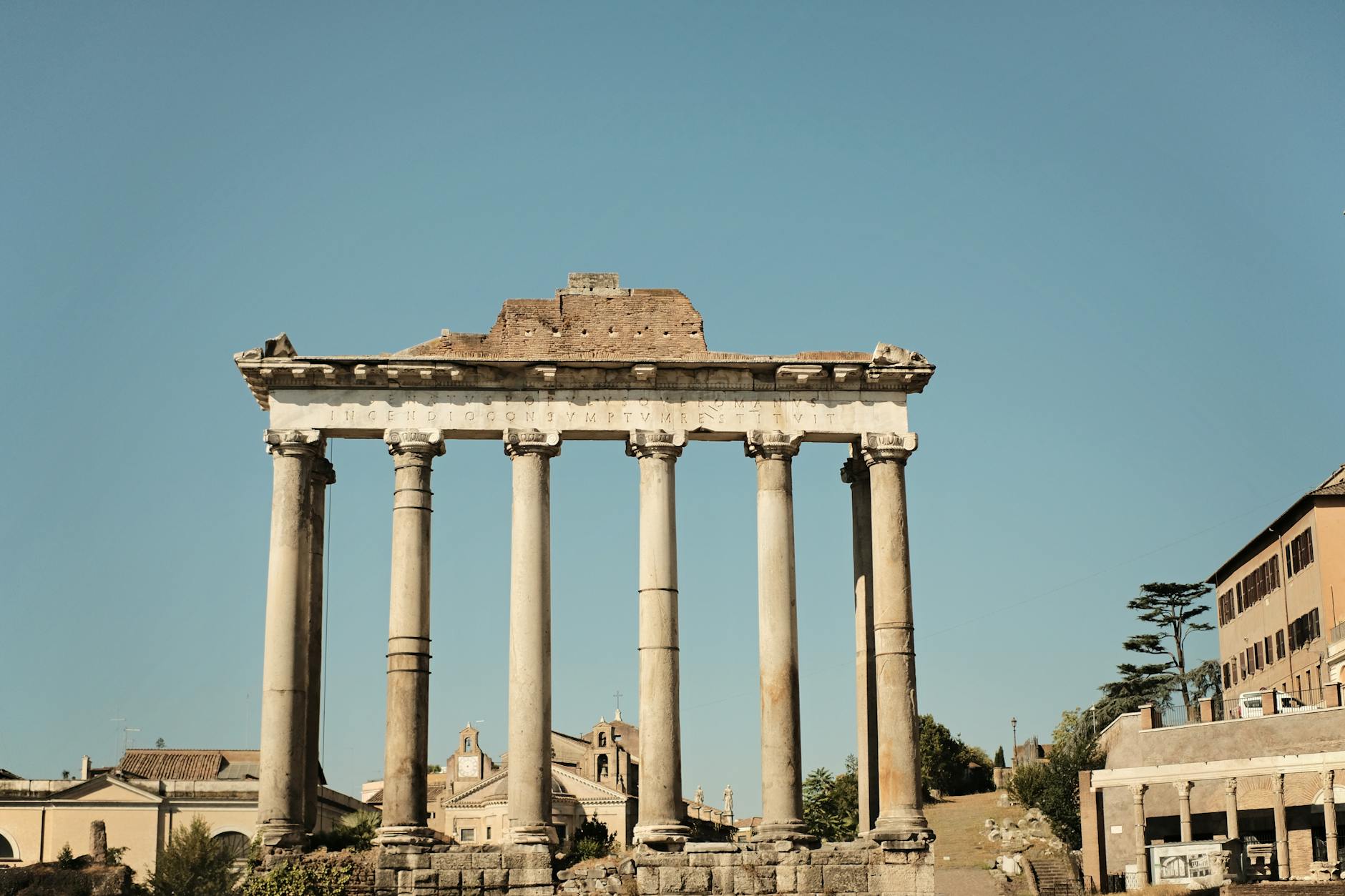
In 1812, Massachusetts Governor Elbridge Gerry signed a redistricting bill so grotesquely contorted that a Boston newspaper compared one of its districts to a salamander. A cartoonist combined the creature with the governor's name, and American political vocabulary acquired a word it has never relinquished. Most Americans assume the story begins there. It does not. It begins, as so many stories about democratic failure do, in Rome — roughly two thousand years earlier.
The Centuriate Assembly and the Illusion of Equal Votes
The Roman Republic was not a democracy in the modern sense, but it was not purely a monarchy either. It occupied that complicated middle ground that most durable political systems eventually inhabit: a structure with genuine popular participation layered over a skeleton of entrenched privilege. The Comitia Centuriata, the centuriate assembly, was the body responsible for electing consuls and passing laws on war and peace. Every male Roman citizen had a vote in it. The patrician class was at considerable pains to ensure that this fact meant almost nothing.
The assembly was divided into units called centuries — nominally military in origin, theoretically proportional, and in practice a masterpiece of structural favoritism. Citizens were sorted first by wealth into five property classes, and then subdivided into centuries within those classes. The wealthiest Romans were organized into eighteen centuries of cavalry and eighty centuries of the first infantry class. The four lower property classes, which contained the overwhelming majority of the citizen population, were allocated fewer centuries in total than the wealthiest tier alone.
Voting proceeded century by century, in order of prestige, until a majority of centuries was reached. The math was not subtle. The top property tier, representing a small fraction of the citizen body, could achieve a majority before the lower classes cast a single ballot. In practice, elections were frequently decided before the urban poor, the smallholders, and the artisans ever entered the voting enclosure. Their votes were not illegal. They were simply unnecessary by design.
The Reformers Who Kept Arriving Too Late
What is striking, reading the record across five thousand years, is not that ruling classes engineer systems to protect themselves. That is expected behavior, as reliable as compound interest. What is striking is how consistently reformers underestimate the depth of the engineering until the moment they attempt to dismantle it.
The Gracchi brothers — Tiberius and Gaius — spent their political careers in the second century BCE attempting to redistribute land and recalibrate Roman political power toward the broader citizen base. Both were killed for it. The centuriate assembly was eventually modified over the Republic's long history, with some reforms redistributing centuries more equitably across the classes. But structural modifications arrived slowly, partially, and always after the class that benefited from the original design had extracted generations of advantage from it.
This is the recurring pattern. The structural manipulation of democratic machinery is rarely dramatic enough to provoke immediate outrage. It does not look like tyranny. It looks like administration. It looks like technical decisions about how votes are counted, how districts are drawn, how ballots are weighted. By the time reformers develop the vocabulary to name what is happening, the system has been operating long enough that its distortions appear normal.
The American Inheritance
The United States inherited both the Roman vocabulary of republicanism and, less advertised, several of its structural habits. The Electoral College was designed in part by men who worried about the unmediated popular will — men who also happened to represent states with large enslaved populations that could not vote but could be counted, at the famous three-fifths ratio, to inflate their states' political weight. The Senate was structured to equalize states rather than populations, a design that has grown more distorting as the population has become more unevenly distributed across the country.
Congressional redistricting — the practice Gerry nominally invented — is now a sophisticated, data-driven enterprise. Mapping software can analyze voting patterns at the precinct level and draw district lines with a precision that would have awed a Roman censor. The technology is new. The underlying logic — concentrate your opponents' votes where they waste the most, disperse your own where they achieve the most — is not new at all. It is the centuriate assembly, running on modern hardware.
Both major American political parties have practiced aggressive redistricting when they held the power to do so. This is not a partisan observation; it is a documented historical one. The instinct belongs to no ideology. It belongs to the psychology of any group that controls the machinery of an election and prefers to keep controlling it.
Why Reformers Keep Losing the First Round
Historians of Roman politics have noted a persistent asymmetry: the patrician class had centuries to develop and refine its structural advantages, while reformers typically had a single political career — often a short one — to challenge them. The same asymmetry appears in every subsequent era. Structural manipulation compounds over time. The districts drawn in one decade shape the legislatures elected in the next, which then draw the districts for the decade after that. Reform movements, by contrast, tend to be episodic, energized by specific crises, and vulnerable to exhaustion.
The other consistent obstacle is legibility. The centuriate assembly was not a secret. Its mechanics were publicly known. Roman citizens were aware, in a general sense, that the wealthy voted first and that their votes carried more structural weight. But awareness is not the same as political capacity to act on that awareness. The system's complexity — its layers of classes, centuries, and procedural rules — made it difficult to hold in the mind as a single, coherent injustice. It presented as a series of technical details rather than a unified design.
Modern gerrymandering benefits from the same cognitive shield. Explaining to a general audience why a particular district map is structurally unfair requires maps, statistics, and patience. Defending the status quo requires only the assertion that lines have to be drawn somewhere.
What History Suggests
The Roman centuriate assembly was eventually replaced — not reformed incrementally, but superseded by other institutions as the Republic transformed into the Empire. That transformation was not an improvement. The lesson is not that structural manipulation eventually corrects itself. The lesson is that it tends to persist until the system it inhabits either reforms itself under sustained pressure or collapses into something worse.
The consistent variable across five thousand years is not the technology of manipulation. It is the psychology of the group that holds the mechanism: the rational calculation that a system which guarantees your political survival is worth defending, and the equally rational calculation, made by reformers, that the cost of confronting that defense is very high. Both calculations are correct. The question every generation faces is which calculation its institutions are designed to overcome.