Inflation is almost never described honestly by the governments that produce it. It arrives wrapped in the language of external forces — supply shocks, global headwinds, speculative markets, the unpredictable behavior of foreign powers. The vocabulary changes with the century. The underlying transaction does not. A government facing a gap between what it has promised and what it can afford makes a choice: accept the political cost of honesty, or distribute that cost invisibly across every person who holds the currency.
They have chosen the second option with remarkable consistency for five thousand years. What follows is not a comprehensive catalog of that consistency. It is a selected tour — five stops across twenty centuries — offered in the conviction that voters who recognize the pattern are considerably harder to mislead than those who encounter each crisis as though it were the first of its kind.
Stop One: Rome's Silver Lie (3rd Century AD)
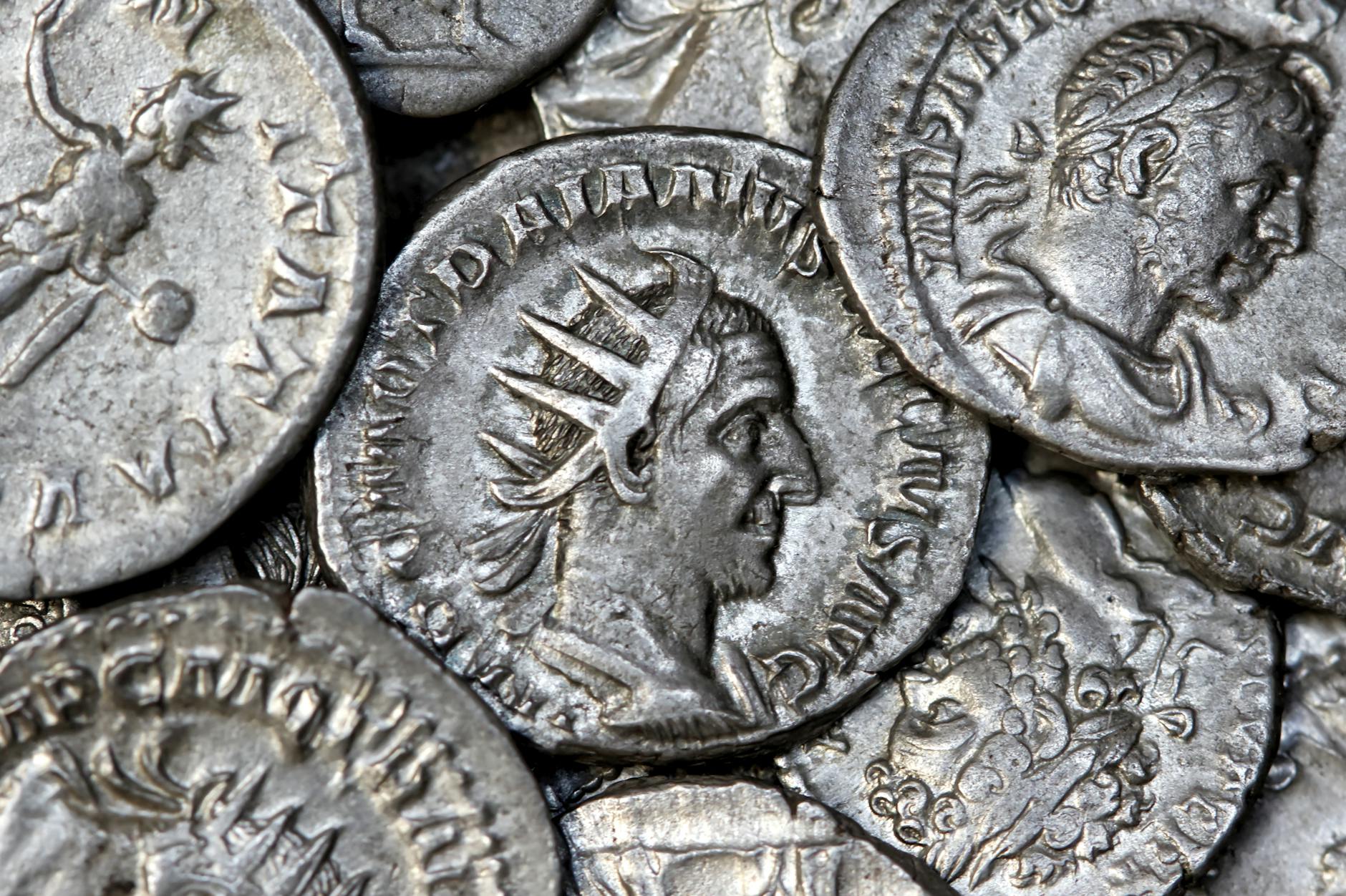
The Roman denarius was, at its peak, a coin of approximately 85 percent silver content. By the reign of Gallienus in the 260s AD, that figure had fallen to somewhere between 2 and 5 percent. The coin still looked like a denarius. It was still called a denarius. It was accepted, under legal compulsion, as though it were a denarius. It was not.
The debasement was not accidental and it was not gradual in any organic sense. It was a policy response to a specific political crisis: the Roman state faced simultaneous pressure on multiple military frontiers, a civil war that cycled through emperors at a pace that made continuity of fiscal policy impossible, and a bureaucratic apparatus whose salaries and loyalties had to be maintained regardless of what the treasury actually contained. Reducing silver content was cheaper than the alternative, which was either raising taxes on a population already under stress or telling the legions they would be paid less.
The result was a price spiral that ancient sources describe with unmistakable clarity — merchants refusing the debased coins, prices for basic goods rising dramatically, and a collapse of confidence in the currency that contributed materially to the broader instability of the third century. The government's response to that collapse was largely to issue edicts commanding that prices not rise, which worked approximately as well as such edicts have worked in every subsequent century.
Stop Two: The Song Dynasty's Paper Experiment (11th–13th Centuries)
China under the Song Dynasty invented paper money — a genuine technological achievement that was also, eventually, a cautionary demonstration of what happens when the mechanism for creating money is separated from any constraint on its creation.
The jiaozi, initially a private merchant instrument, was nationalized by the Song government and became the world's first state-issued fiat currency. For a period, it functioned well. Then the dynasty faced military pressure from the north — first the Jurchen Jin, eventually the Mongols — and the cost of that pressure was enormous. The government's response was to issue more paper. Then more. The issuance was not publicly announced as a tax, though that is precisely what it was. It was framed as a monetary accommodation. By the time the Southern Song were making their final stand against Kublai Khan's forces, the paper currency had lost the overwhelming majority of its purchasing power. Soldiers were being paid in instruments that merchants refused to accept.
The political decision preceded the economic consequence by decades. The economic consequence was presented to the population as a feature of the crisis rather than as a choice made in response to it.
Stop Three: Revolutionary France and the Assignat (1789–1796)
The French Revolution inherited a state that was effectively bankrupt — a condition that had itself been a proximate cause of the Revolution. The solution devised by the National Assembly was elegant in theory: issue paper currency backed by the value of confiscated Church and aristocratic lands, which would be sold off over time to retire the currency. The assignat would be, in this framing, not money creation but a kind of bridge loan against real assets.
In practice, the Assembly printed far more assignats than the underlying land could support, for the straightforward reason that war, internal rebellion, and the administrative chaos of a government that was reorganizing itself while simultaneously fighting for survival made fiscal restraint politically impossible. By 1796, the assignat had lost roughly 99 percent of its face value. The Directory abolished it and replaced it with a new instrument, the mandat territorial, which collapsed within months. France ultimately stabilized its currency only after Napoleon imposed a set of fiscal constraints that required the kind of centralized authority the Revolution had theoretically been fought to prevent.
At every stage, the inflation was described to the French public as a consequence of enemies — foreign powers, internal counter-revolutionaries, speculators. The possibility that the Assembly's own issuance decisions were the primary driver was not a popular subject of official discussion.
Stop Four: Weimar Germany (1921–1923)
This is the inflation most Americans have encountered, usually through the image of a wheelbarrow full of banknotes being pushed to the bakery to buy a loaf of bread. The image is accurate. The standard explanation — that the hyperinflation was caused by the punishing reparations demands of the Versailles Treaty — is incomplete in ways that matter.
Germany's inflation began before the most severe reparations demands were formalized, and it accelerated in direct response to political decisions made by the German government. Most significantly, when France occupied the Ruhr in 1923 to enforce reparations collection, the German government responded with a policy of passive resistance — encouraging workers to strike and printing money to pay their wages. This was a deliberate political choice, made for comprehensible political reasons, that transformed a serious inflation into a catastrophic one.
The German middle class, whose savings were annihilated, did not receive a clear account of this sequence from their government. They received, instead, a narrative centered on foreign exploitation. That narrative was not entirely false. It was sufficiently incomplete to be functionally misleading, and the political uses to which that misleading narrative was subsequently put are well documented.
Stop Five: The United States, 2020–2023
The American inflation that peaked in 2022 at approximately 9.1 percent — the highest in four decades — arrived with a bipartisan political consensus that it was primarily a supply-chain phenomenon, a consequence of pandemic disruption to global logistics. That was a partial description of a more complete truth.
Between 2020 and 2021, the United States expanded its money supply by a historically extraordinary margin. Fiscal transfers to households were substantial and deliberately so — the political calculation on both sides of the aisle was that the cost of under-responding to the pandemic recession was higher than the cost of over-responding. That calculation may have been correct. What was not correct was the subsequent presentation of the resulting inflation as primarily an external phenomenon rather than a predictable consequence of a deliberate policy choice.
The Federal Reserve's communications, the Congressional testimony, the press releases — they were not fabrications. They were framings. The distinction between those two things is exactly what five thousand years of monetary history teaches readers to notice.
What the Pattern Means
No government in this survey set out to destroy its currency. Each made a series of individually defensible decisions under genuine pressure, and each declined, at the moment of decision, to be fully transparent with its population about the costs being distributed. The citizens of each society were, in the aggregate, made poorer by choices they did not know were being made on their behalf.
The mechanism has been updated. The language has been professionalized. The evasion is the same evasion it has always been, and it relies, as it has always relied, on a population that encounters each crisis as though it were unprecedented. It is not unprecedented. It is Tuesday.