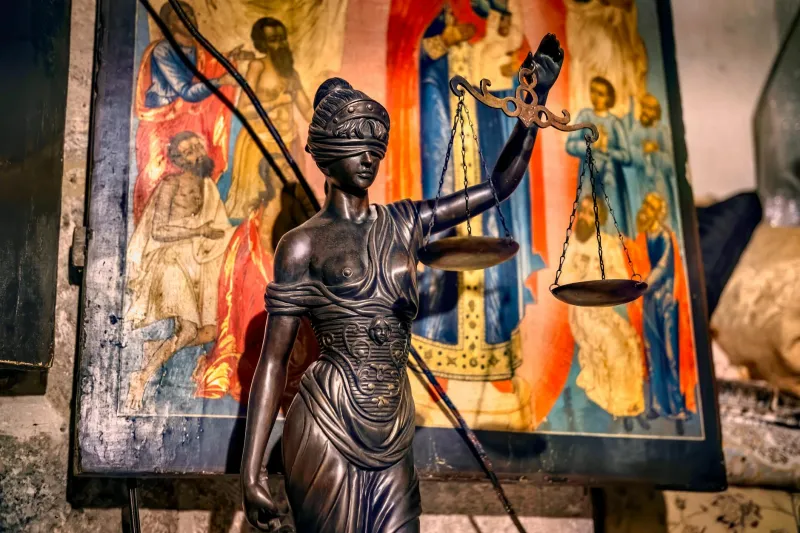
The Impossible Mathematics of Justice
In 1975, as Francisco Franco lay dying in a Madrid hospital, Spain faced a calculation that has confronted every society emerging from authoritarian rule: what do you do with the people who made atrocity possible?
 Photo: Francisco Franco, via c8.alamy.com
The answer Spain chose became known as the "Pacto del Olvido" — the Pact of Forgetting. In exchange for a peaceful transition to democracy, the country would simply agree to forget. No trials for Franco's collaborators. No investigations into the disappeared. No official acknowledgment of the regime's crimes. Just silence, and the hope that silence would be enough.
This wasn't unique to Spain. It's a pattern that repeats across cultures and centuries, revealing something uncomfortable about human nature: when faced with the choice between justice and stability, societies almost always choose stability. The cost of this choice only becomes apparent decades later, when the unresolved trauma reasserts itself in new and often more virulent forms.
The Seductive Logic of Moving On
The appeal of amnesty is obvious and immediate. Prosecuting the guilty means relitigating the past, reopening wounds, and potentially destabilizing whatever fragile peace has been achieved. It means admitting that neighbors participated in unspeakable acts, that institutions everyone depends on were compromised, and that the moral universe is far more complex and disturbing than anyone wants to acknowledge.
Forgetting, by contrast, offers the psychological comfort of a clean slate. It allows societies to pretend that whatever happened was an aberration, a temporary madness that has now passed. It enables the fantasy that "good people" and "bad people" are easily distinguishable, and that the bad people are now gone.
This logic shaped America's approach to Reconstruction after the Civil War. Rather than systematically prosecuting Confederate leadership or fundamentally restructuring Southern society, the country chose reconciliation. The result was the Lost Cause mythology, Jim Crow laws, and a century of institutionalized terrorism that arguably didn't end until the 1960s — and whose effects persist today.
The same pattern played out after Watergate, when Gerald Ford's pardon of Richard Nixon was justified as necessary for "healing the nation." The immediate crisis passed, but the precedent was established: American presidents are effectively above the law, a principle that has shaped every subsequent constitutional crisis.
The Neuroscience of Collective Memory
Recent research in neuroscience and psychology helps explain why societies consistently make this choice. Human brains are wired to prioritize immediate threats over long-term consequences, and the immediate threat of social upheaval always feels more urgent than the abstract possibility of future recurrence.
Moreover, collective memory functions differently than individual memory. While individuals can suppress traumatic experiences, societies require active, ongoing effort to maintain historical narratives. Without institutions specifically designed to preserve difficult truths — truth commissions, memorials, educational curricula — the natural tendency is for uncomfortable facts to fade from public consciousness.
This creates what historians call "structural amnesia" — not the deliberate suppression of memory, but its passive erosion through institutional neglect. Spain's experience illustrates this perfectly: by the 2000s, an entire generation had grown up with no knowledge of Franco's crimes, creating space for revisionist narratives that portrayed the dictatorship as a period of necessary order.
The South African Exception That Proves the Rule
South Africa's Truth and Reconciliation Commission is often cited as a successful alternative to the amnesty trap, but closer examination reveals how rare and fragile such alternatives actually are. The TRC worked because it emerged from a unique set of circumstances: a negotiated transition where both sides retained significant power, international pressure for accountability, and leadership committed to the difficult work of confrontation rather than avoidance.
 Photo: South Africa, via upload.wikimedia.org
Even then, the commission's success was partial at best. While it created a comprehensive record of apartheid's crimes and provided a forum for victims to tell their stories, it failed to address the economic inequalities that had sustained the system. Thirty years later, South Africa remains one of the world's most unequal societies, and many of the structural conditions that enabled apartheid persist in modified form.
The TRC's relative success highlights what makes amnesty so tempting: genuine accountability requires not just acknowledgment of past crimes, but fundamental restructuring of the systems that enabled them. Amnesty promises the benefits of moving forward without the costs of moving differently.
The American Pattern
The United States has faced the amnesty calculation repeatedly throughout its history, and the pattern of its choices reveals something important about American political psychology. From the post-Civil War reconciliation to the Iran-Contra pardons to the decision not to prosecute Bush administration officials for torture, America consistently chooses institutional stability over individual accountability.
This pattern reflects a deeper American belief that the system itself is fundamentally sound, and that any problems are the result of individual bad actors rather than structural flaws. This worldview makes amnesty psychologically easier because it preserves faith in institutions while scapegoating individuals who can then be forgotten.
But this approach has costs that compound over time. Each unprosecuted abuse of power establishes precedent for the next one. Each decision to "move forward" rather than "look backward" creates space for more sophisticated forms of the same underlying pathology.
The Generational Reckoning
Perhaps the most disturbing aspect of the amnesty trap is how its costs are distributed across time. The generation that chooses forgetting usually experiences its benefits: reduced conflict, preserved institutions, and the comfort of avoiding difficult confrontations. But subsequent generations inherit the consequences: normalized authoritarianism, weakened institutional constraints, and the gradual erosion of democratic norms.
Spain's experience illustrates this dynamic clearly. The generation that lived through Franco's dictatorship and chose the Pact of Forgetting avoided civil war and achieved a successful transition to democracy. But their children and grandchildren inherited a political culture where authoritarianism was never fully delegitimized, creating space for the rise of parties like Vox that explicitly rehabilitate Franco's legacy.
Similarly, America's failure to fully reckon with slavery and its aftermath didn't prevent the Civil War from ending — but it did ensure that the fundamental questions raised by that conflict would resurface repeatedly throughout American history, from Reconstruction to Jim Crow to the civil rights movement to contemporary debates about Confederate monuments.
The Path Not Taken
Historical analysis suggests that societies capable of genuine accountability share certain characteristics: strong civil society institutions, broad consensus about democratic values, and leadership willing to accept short-term political costs for long-term institutional health. These conditions are rare, which explains why the amnesty trap is so common.
But when societies do manage to avoid the trap, the benefits compound across generations. Germany's post-war denazification process, despite its imperfections, created a political culture where authoritarianism became genuinely illegitimate. This didn't happen automatically — it required decades of sustained effort, institutional design, and cultural change. But the result was a democracy that has proven remarkably resilient to the authoritarian pressures that have destabilized other European countries.
The lesson from five thousand years of history is uncomfortable but clear: societies get the reckonings they choose. Those that choose amnesty may achieve temporary peace, but they sacrifice the possibility of genuine transformation. Those that choose accountability may face immediate turmoil, but they create the foundation for lasting democratic resilience.
The question facing any society emerging from authoritarian or criminal governance isn't whether to choose between justice and stability — it's whether to pay the costs of accountability now, or leave them for future generations to bear.