The Vote That Changed Everything
In 415 BCE, Athens held what historians would later recognize as a referendum on democracy itself. Someone had vandalized the city's sacred statues on the eve of the Sicily expedition, and paranoia gripped the Assembly. Rather than investigate the actual crime, Athenians voted to expand the powers of denunciation, allowing citizens to accuse anyone of impiety or treason based on rumor alone.
The man who proposed this expansion, Androcles, claimed it was temporary emergency legislation. The crisis demanded extraordinary measures, he argued, and extraordinary measures demanded extraordinary powers. The Assembly agreed. Within months, Athens was prosecuting its own generals, exiling its most capable leaders, and treating political opposition as criminal conspiracy.
The democracy that had defeated the Persian Empire began devouring itself through legalized paranoia. The pattern was set, and it would repeat across continents and centuries with mechanical precision.
The Architecture of Democratic Self-Destruction
Every democracy that criminalizes dissent follows the same blueprint. First comes the crisis — real or manufactured, external or internal, it doesn't matter. What matters is the psychological state it creates: a population convinced that normal political opposition represents existential threat.
Next comes the legislation, always presented as temporary and targeted. The Alien and Sedition Acts of 1798 were supposed to expire after four years and only affect foreign agitators. The Espionage Act of 1917 was designed for wartime conditions and enemy agents. The Smith Act of 1940 targeted only those who advocated violent overthrow of the government.
Each law expanded beyond its stated purpose with inevitable logic. The Sedition Act prosecuted American citizens for criticizing President Adams. The Espionage Act imprisoned socialist leader Eugene Debs for giving an anti-war speech. The Smith Act was used against Communist Party members whose most dangerous activity was distributing pamphlets.
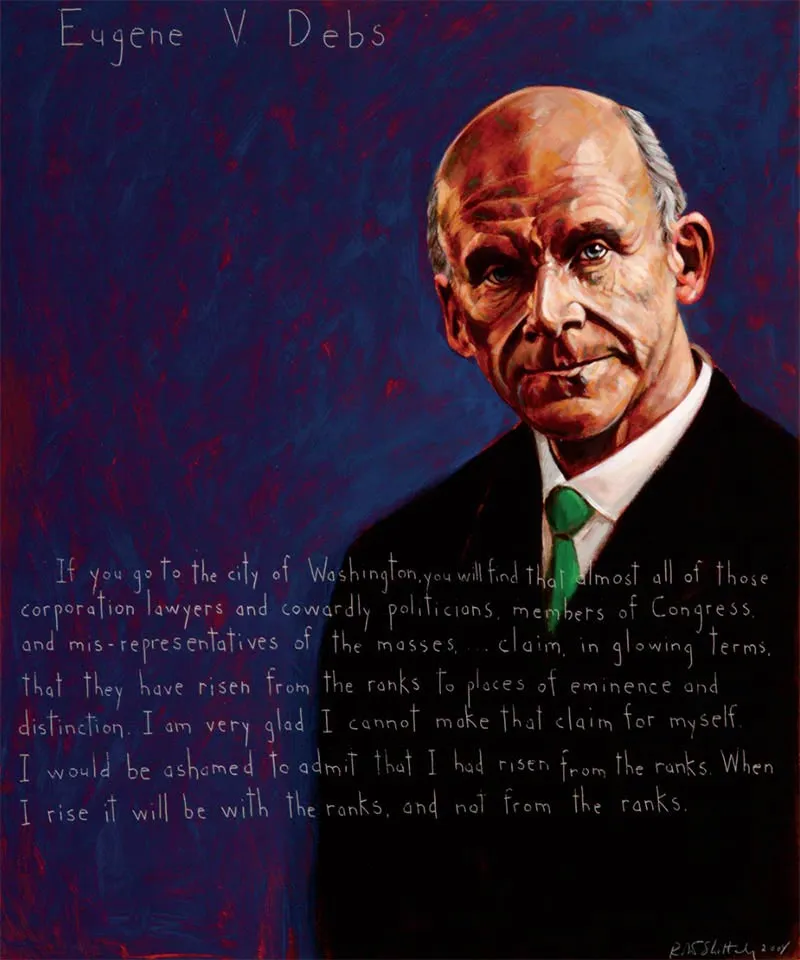 Photo: Eugene Debs, via americanswhotellthetruth.org
The Athenian Template
Athens provides the clearest example because its democracy was direct rather than representative. When Athenians decided to criminalize political opposition, they did so explicitly and publicly, leaving detailed records of their reasoning.
The process began with ostracism, a constitutional mechanism for exiling prominent citizens without trial or charges. Originally designed to prevent tyranny, ostracism became a tool for eliminating political rivals. Aristides the Just — literally nicknamed for his integrity — was ostracized because citizens grew tired of hearing about his virtue.
 Photo: Aristides the Just, via cdn.britannica.com
But ostracism required no criminal conviction, only popular disapproval. The next step was treating political opposition as actual crime. The graphe paranomon allowed citizens to prosecute anyone who proposed illegal legislation, but "illegal" gradually expanded to mean "politically inconvenient." By the end of the fifth century, Athens was prosecuting generals for winning battles the wrong way.
The American Iterations
The Federalists who passed the Alien and Sedition Acts genuinely believed they were saving democracy from Jacobin subversion. French revolutionary ideas were spreading through Democratic-Republican societies, and President Adams faced a potential war with France. The legislation seemed reasonable: expel dangerous foreigners, prosecute seditious speech, protect national security.
But the definition of "seditious" proved elastic. Congressman Matthew Lyon was imprisoned for writing that President Adams displayed "a continual grasp for power" and "an unbounded thirst for ridiculous pomp." The crime wasn't treason or espionage — it was political criticism that might reduce public confidence in government.
The pattern repeated during World War I, when the Espionage Act transformed anti-war sentiment into criminal activity. Socialist Party leader Eugene Debs received a ten-year sentence for telling an audience that "the master class always declares the wars, and the subject class always fights the battles" — a statement that would be unremarkable in any other democratic context.
The Normalization Process
What makes democratic censorship particularly dangerous is how quickly extraordinary becomes ordinary. The generation that passes emergency legislation believes it's temporary. The generation that grows up under those laws believes they're normal.
Consider how the Smith Act, passed in 1940 as anti-Nazi legislation, became the primary tool for prosecuting American communists during the Cold War. By the 1950s, Americans who had never known politics without anti-communist prosecutions treated ideological persecution as a normal feature of democratic life.
This normalization explains why democratic societies rarely repeal censorship laws even after the crises that inspired them have passed. The Espionage Act remains in force more than a century after World War I ended. The legal infrastructure for criminalizing dissent becomes permanent even when the political justification disappears.
The Opposition's Dilemma
Democratic oppositions face an impossible choice when governments begin criminalizing dissent. Comply with unjust laws and legitimize authoritarian expansion, or resist and provide evidence for claims about dangerous extremism.
Athens' democratic opposition chose compliance, believing they could outlast temporary emergency measures. Instead, they discovered that compliance made them complicit in democracy's gradual strangulation. By the time they recognized the threat, legal opposition had become impossible.
American oppositions have chosen different strategies with mixed results. Thomas Jefferson's Democratic-Republicans used the election of 1800 to repeal the Alien and Sedition Acts, but only after those laws had established precedents for future use. The Communist Party challenged Smith Act prosecutions in court but lost members to imprisonment and intimidation.
The Judicial Enablers
Democratic judiciaries consistently fail to prevent the criminalization of political opposition, not through malice but through institutional logic. Courts defer to legislative judgments about national security, particularly during crises when public opinion supports expanded government powers.
The Supreme Court upheld Espionage Act prosecutions in Schenck v. United States, creating the "clear and present danger" standard that would justify decades of political prosecutions. The Court later upheld Smith Act convictions in Dennis v. United States, ruling that advocating communist revolution posed sufficient danger to justify restricting speech.
These decisions weren't aberrations — they reflected judicial institutions designed to interpret law rather than resist popular pressure. When democracies vote to criminalize their opposition, courts typically provide legal rationales rather than constitutional obstacles.
The International Pattern
The progression from democratic crisis to opposition criminalization appears across cultures and centuries with stunning consistency. Weimar Germany's emergency decrees, Venezuela's media restrictions, Hungary's civil society laws — each follows the same script of crisis, legislation, normalization, and expansion.
This universality suggests something deeper than political calculation. Democracies that criminalize dissent are responding to genuine psychological pressure — the cognitive discomfort of managing political disagreement during periods of perceived threat. Criminalizing opposition provides emotional relief even when it provides no practical security.
The Recovery Problem
Democracies can recover from criminalizing their opposition, but the process requires more than repealing bad laws. It demands rebuilding democratic norms that legal persecution has undermined.
Athens never fully recovered from its late-fifth-century paranoia. The democracy that emerged after the Thirty Tyrants was more cautious, more conservative, and ultimately more vulnerable to Macedonian conquest. The psychological damage of democratic self-persecution lasted longer than the laws that caused it.
America has repeatedly recovered from periods of political prosecution, but each recovery leaves residual infrastructure for future abuse. The legal precedents, institutional mechanisms, and cultural acceptance of emergency powers accumulate across generations, making the next crisis more dangerous than the last.
The Eternal Vigilance
Every generation of democrats believes their system is too mature, too sophisticated, too enlightened to criminalize political opposition. Every generation discovers that democratic institutions provide no automatic protection against democratic voters who demand such criminalization.
The pattern persists because the psychology persists. Humans under stress prefer simple solutions to complex problems, and criminalizing opposition is always simpler than tolerating disagreement. The question isn't whether future democracies will face this temptation, but whether they'll recognize it before it's too late.