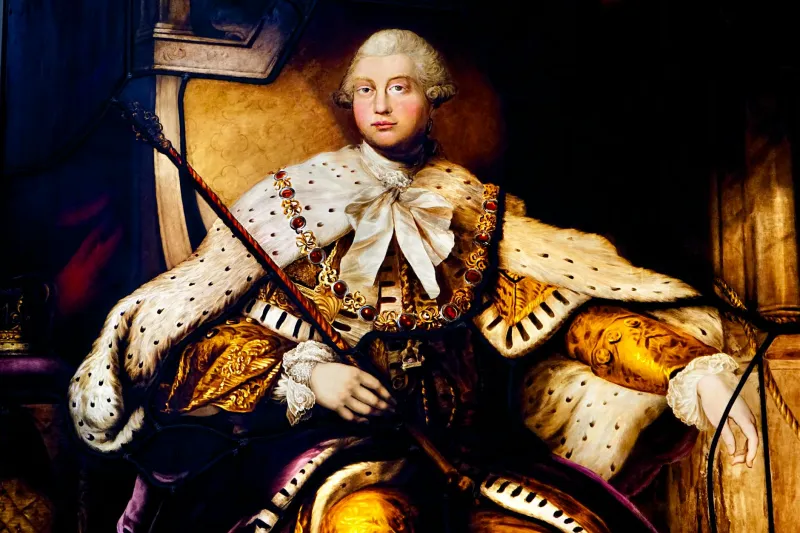
Ptolemy XV, the last pharaoh of Egypt, inherited the throne of the richest kingdom in the Mediterranean world. His bloodline traced back through three centuries of rulers who had commanded vast armies, built magnificent cities, and patronized the greatest library in human history. Yet when Roman legions approached Alexandria in 30 BCE, this heir to one of history's most successful dynasties was seventeen years old, politically irrelevant, and entirely dependent on his mother, Cleopatra VII, for any semblance of authority.
 Photo: Ptolemy XV, via c8.alamy.com
Ptolemy XV's fate — inheriting everything and possessing nothing — represents one of history's most consistent patterns. Across five millennia and every continent, dynasties have followed the same trajectory: brilliant founders create lasting institutions, competent successors maintain them, and subsequent generations systematically destroy what their ancestors built.
The Founder's Dilemma
Every dynasty begins with someone who possesses extraordinary capabilities: military genius, political cunning, economic insight, or some combination that allows them to seize power from established authorities. These founders typically rise from relatively modest circumstances, developing their skills through necessity and competition. They understand intimately how power works because they had to take it from someone else.
The founder's children face an entirely different challenge. Rather than learning to acquire power, they must learn to maintain it. Rather than competing against equals, they are surrounded by subordinates. Rather than developing skills through adversity, they are protected from consequences by their position.
This creates what we might call the "founder's dilemma." The very success that establishes a dynasty removes the conditions that created the founder's capabilities. Children raised in palaces don't develop the street-smart instincts that built the palace. Heirs educated by tutors selected for their loyalty rather than their honesty don't learn to distinguish flattery from truth.
Consider the arc of the Habsburg dynasty. Charles V, Holy Roman Emperor in the 16th century, was one of history's most capable rulers, managing an empire that spanned from Spain to Austria while navigating the Protestant Reformation and Ottoman expansion. His son, Philip II, proved competent enough to maintain Spanish dominance for another generation. But subsequent Habsburg rulers demonstrated increasingly poor judgment, culminating in Charles II of Spain, whose physical and mental disabilities were so severe that his death without an heir triggered a continent-wide war.
The Habsburg decline wasn't unique — it was typical. The Ptolemies of Egypt, the Julio-Claudian emperors of Rome, the Bourbon kings of France, and the Qing emperors of China all followed similar patterns of initial brilliance followed by gradual deterioration and eventual collapse.
The Skills That Don't Transfer
Why don't the abilities that create dynasties pass to the next generation? The answer lies in understanding what those abilities actually are. Successful founders typically possess three crucial capabilities: accurate risk assessment, coalition building, and adaptive learning. Each of these skills requires specific environmental conditions to develop — conditions that dynasties systematically eliminate for their children.
Accurate risk assessment develops through exposure to genuine consequences. Founders learn to distinguish real threats from imaginary ones because making wrong assessments means losing everything. Their children, protected by inherited wealth and institutional power, rarely face situations where their personal judgment determines their survival. Instead, they're surrounded by advisors whose job is to minimize risk, creating a bubble of artificial safety that distorts their understanding of how the world actually works.
Coalition building requires understanding what different groups want and how to align those interests with your own objectives. Founders master this through necessity — they must convince others to follow them despite having no inherited authority. Their children inherit ready-made coalitions of supporters whose loyalty is tied to institutional position rather than personal capability. This creates the illusion that leadership is about giving orders rather than building consensus.
Adaptive learning — the ability to change strategies when circumstances change — requires intellectual humility and willingness to admit error. Founders develop this through repeated failure and adjustment. Their children are taught from birth that they are special, destined to rule, inherently superior to those around them. This psychological conditioning makes it nearly impossible to acknowledge mistakes or adapt to new realities.
The American Exception That Proves the Rule
The United States was explicitly designed to avoid hereditary leadership, yet American political dynasties demonstrate the same patterns as ancient monarchies. The Adams family produced two presidents separated by a generation — John Adams, a brilliant political theorist and skilled diplomat, and John Quincy Adams, a capable but politically tone-deaf leader who won the presidency through a contested election and lost reelection decisively.
The Kennedy dynasty offers an even clearer example. Joseph P. Kennedy Sr. built enormous wealth and political influence through ruthless business dealing and strategic alliance-building during the Depression era. His sons inherited vast resources and political connections, but their careers were marked by increasingly poor judgment: John F. Kennedy's reckless personal behavior and foreign policy miscalculations, Robert Kennedy's prosecutorial overreach, and Ted Kennedy's Chappaquiddick scandal.
More recently, the Bush family demonstrates how political skills deteriorate across generations. Prescott Bush was a successful businessman and effective senator. His son, George H.W. Bush, was a skilled diplomat and competent president. His grandson, George W. Bush, despite winning two presidential elections, was widely criticized for poor decision-making during the Iraq War and financial crisis.
Even the Clinton and Trump family political operations show signs of this pattern. Both Hillary Clinton and Donald Trump Jr. inherited vast political networks and name recognition, yet neither demonstrated their predecessors' instinctive understanding of public sentiment or ability to build sustainable coalitions.
The Psychology of Inherited Authority
What psychological mechanisms cause this consistent deterioration? Research in developmental psychology suggests that children who grow up with inherited advantages develop what researchers call "external locus of control" — they attribute their successes to circumstances rather than their own abilities. This creates a fundamental misunderstanding of cause and effect in leadership situations.
Moreover, inherited authority creates what we might call "feedback distortion." When your position depends on bloodline rather than performance, the people around you have strong incentives to tell you what they think you want to hear rather than what you need to know. Over time, this creates an increasingly inaccurate understanding of reality.
The most damaging effect, however, may be what psychologists call "learned helplessness" in reverse. While traditional learned helplessness involves believing you can't control outcomes, inherited authority creates "learned omnipotence" — the belief that you can control outcomes without understanding the mechanisms involved. This leads to overconfidence in situations requiring careful judgment and preparation.
The Institutional Decay Pattern
Dynastic decline doesn't happen in isolation — it parallels institutional decay within the organizations dynasties control. Founders typically build institutions based on merit and performance because they need capable subordinates to maintain power against rivals. As dynasties consolidate control, however, loyalty becomes more important than competence in subordinate selection.
This creates a feedback loop: incompetent heirs promote incompetent subordinates, who provide poor advice, leading to worse decisions, which require more loyal (and less competent) subordinates to implement. The institution gradually loses its ability to function effectively, making the dynasty more vulnerable to external challenges precisely when its leadership is least capable of responding.
The pattern played out clearly in the Soviet Union, where the Communist Party evolved from a revolutionary organization led by intellectuals like Lenin and Trotsky into a hereditary bureaucracy dominated by the children of party officials. By the 1980s, the leadership was so insulated from reality that they couldn't recognize the system's fundamental problems until it collapsed around them.
Modern Manifestations
Contemporary American politics shows clear signs of this ancient pattern. Political dynasties increasingly dominate both parties, with family connections becoming more important than individual capabilities in candidate selection. The result is a political class that often seems disconnected from the concerns of ordinary voters and incapable of addressing complex policy challenges.
Corporate America demonstrates similar trends. Family-controlled businesses, despite some notable exceptions, typically underperform professionally managed companies over multiple generations. The same psychological and institutional factors that undermine political dynasties — inherited authority, feedback distortion, loyalty over competence — create similar problems in business contexts.
Technology companies, despite their emphasis on innovation and meritocracy, are beginning to show early signs of dynastic thinking as founders' children reach adulthood. Whether Silicon Valley can avoid the historical pattern remains an open question, but the psychological forces that create dynastic decline operate regardless of industry or era.
The Democratic Antidote
Democratic institutions theoretically provide an antidote to dynastic decline by forcing leaders to compete for authority rather than inheriting it. Yet American democracy's increasing tolerance for political dynasties suggests that even democratic systems can gradually evolve toward hereditary leadership if voters become sufficiently disconnected from the selection process.
The key insight from five thousand years of dynastic history is that the problem isn't individual pathology but systemic psychology. Any system that allows authority to be inherited rather than earned will gradually select for people who possess titles rather than capabilities. The question for American democracy is whether it can maintain competitive selection mechanisms or whether it will follow the historical pattern toward dynasties that inherit everything and accomplish nothing.
History suggests that societies get the leaders they select for. When they select for bloodlines, they get heirs. When they select for capabilities, they get leaders. The choice, as always, remains ours — until we forget that we have one.